Nyrqelavol
Anchor Blueprint
Anchor Blueprint
Couldn't load pickup availability
1. Problem Statement
Larger coding projects can become difficult to maintain when planning, logic, stored information, and output are mixed within the same file. Learners may understand individual Python concepts but remain uncertain about arranging them into a coherent project structure. Changes in one section can create unexpected behaviour in another section when responsibilities are not clearly separated. Testing is sometimes left until the end, making errors harder to trace and revise. Anchor Blueprint addresses these challenges through a structured approach to project planning, component design, testing, and documentation.
2. Solution
Anchor Blueprint guides learners through the stages of designing and building a multi-component Python project. Each module focuses on one responsibility, including planning, configuration, data handling, processing logic, testing, and reporting. Learners practise defining clear boundaries between project sections before writing broader code. Testing activities are introduced alongside development rather than treated as a final task. The closing project combines these methods within one organised workflow supported by planning notes and review materials.
3. What’s Inside
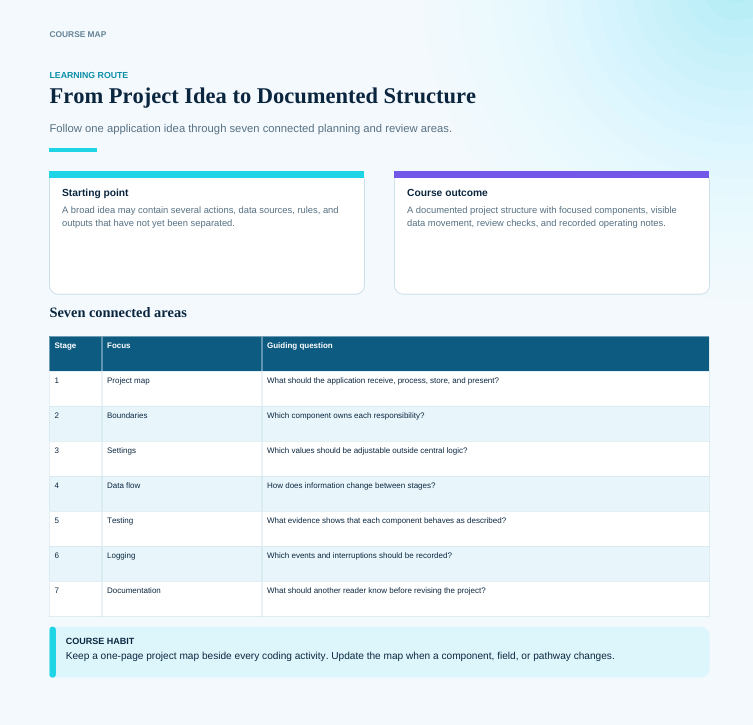
The opening module introduces project mapping. Learners define the purpose of a project, identify required inputs, describe expected outputs, and divide the work into smaller components. Planning worksheets help organise responsibilities before coding begins.
A project-structure module explores how files and folders can be arranged by purpose. Learners separate configuration values, reusable classes, helper functions, processing logic, and output formatting. Examples show how clear naming and focused responsibilities improve readability.
The configuration section explains how adjustable values can be stored outside the central logic. Learners practise working with settings, validation rules, file locations, category labels, and processing options.
A dedicated data-flow module follows information from its original input through validation, conversion, processing, storage, and final output. Learners create diagrams that show how values move between functions and classes.
The testing section introduces focused checks for individual components. Learners compare expected and actual results, prepare sample inputs, examine boundary cases, and record observed behaviour. Activities also explore how changes can be reviewed without repeating every project step manually.
Another module covers logging and structured status messages. Learners practise recording meaningful events, unsuitable input, completed stages, and interrupted operations without filling the output with unnecessary details.
The documentation section focuses on project notes, function descriptions, class summaries, setup instructions, and usage examples. Learners review how documentation can explain the purpose and structure of a project to another reader.
The closing activity involves creating a configurable information organiser. Learners plan the architecture, divide responsibilities, validate incoming records, process and group information, store selected results, test individual components, and prepare clear documentation.
Included materials:
- Project-mapping worksheets
- Architecture planning diagrams
- Structured code examples
- Configuration activities
- Data-flow exercises
- Component testing tasks
- Boundary-case checklists
- Logging examples
- Documentation templates
- Code-review questions
- Module summaries
- A guided closing project
4. Who Is This For?
Anchor Blueprint is intended for learners who already work with classes, files, generators, error management, and structured data workflows. It suits learners continuing from Slate Deck or those who want to organise broader Python projects into focused components.
The course is also relevant for learners who have built several smaller scripts and now want a clearer method for planning, testing, and documenting connected code.
5. What You’ll Learn
- How to map a project before coding
- How to divide work into focused components
- How to arrange files by responsibility
- How to manage configuration values
- How to trace information through a workflow
- How to separate validation from processing
- How to prepare focused component tests
- How to examine boundary cases
- How to compare expected and actual results
- How to record useful project events
- How to write clear project documentation
- How to review connected code structures
- How to build a configurable information organiser
6. 30-Day Refund Policy
Refund requests for Anchor Blueprint may be submitted within 30 days of the original purchase date. Each request is reviewed according to the refund terms published on the Nyrqelavol website.
Learners should provide their order details and the email address used during checkout. Approved refunds are returned through the original payment method. Processing periods may vary depending on the payment provider and banking procedures.
How are the course materials organised?
How are the course materials organised?
Each course is divided into structured modules that introduce Python concepts in a logical order. Topics include explanations, examples, guided tasks, and practice activities. Learners can move through the materials according to their own study schedule.
Do I need previous coding knowledge?
Do I need previous coding knowledge?
Previous coding experience is not required for introductory tiers. Each tier clearly outlines its intended learner level and the topics included. Higher tiers build on earlier concepts and introduce broader exercises, workflows, and project-based tasks.
What format do the courses use?
What format do the courses use?
The courses include written lessons, practical examples, code samples, exercises, reference materials, and module summaries. Some tiers also contain planning worksheets, project briefs, review tasks, and reusable coding structures.
Self-paced learning overview
- 📘 Digital file available after purchase
- 🗂️ Long-term availability
- 🔒 Secure checkout
- 🗓️ Content updated in 2026
Share