Nyrqelavol
Cipher Archive
Cipher Archive
Couldn't load pickup availability
1. Problem Statement
Learners may feel comfortable writing short programs but encounter difficulties when a task involves stored files, several data groups, or multiple code sections. Information can become difficult to manage when it is placed directly inside one long script. Unexpected input or missing data may also cause a program to stop before completing its work. Many learning materials introduce these topics separately without showing how they connect within a complete workflow. Cipher Archive addresses this gap through structured modules focused on organised data processing and dependable code behaviour.
2. Solution
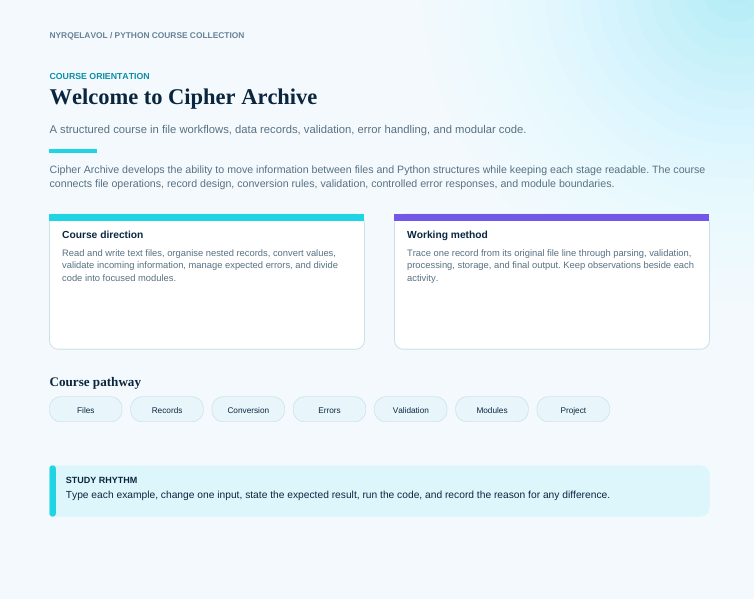
Cipher Archive presents a guided route for working with files, structured data, modules, and common coding errors. Each topic begins with a focused explanation and continues through annotated examples and practical tasks. Learners practise separating responsibilities across functions and code files rather than placing every instruction in one location. Error-handling activities demonstrate how programs can respond to missing, incorrect, or unexpected information. The closing project combines these ideas within a structured information-processing workflow.
3. What’s Inside
The opening module introduces text-file workflows. Learners examine how to open a file, read its contents, add new information, replace existing content, and close the file correctly. Activities include processing notes, storing simple records, and reviewing lines individually.
A structured-data module explores how lists and dictionaries can represent related information. Learners practise creating nested collections, retrieving selected values, updating records, and preparing information for storage.
The course then introduces data conversion. Examples show how text values can be converted into numbers, how stored information can be separated into useful parts, and how output can be formatted for clearer reading.
A dedicated error-management section examines common runtime issues. Learners work with protected code blocks, identify different error categories, and prepare alternative responses when information is missing or entered in an unsuitable format.
The modular-code section explains how functions and related instructions can be organised across separate files. Learners review import structures, reusable helpers, naming choices, and methods for keeping larger scripts readable.
Another module focuses on validation. Activities show how to check user input, confirm required fields, identify empty values, and prevent unsuitable information from moving through later stages of a program.
The closing project involves building a small archive manager. Learners create records, store them in a file, retrieve selected entries, update information, validate input, and manage common errors.
Included materials:
- Structured written modules
- Annotated coding examples
- File-reading and file-writing tasks
- Nested collection exercises
- Data-conversion activities
- Error-management practice
- Input-validation worksheets
- Modular-code examples
- Module summaries
- A guided archive project
- Reference notes for continued study
4. Who Is This For?
Cipher Archive is intended for learners who already understand variables, collections, loops, conditions, and functions. It suits learners continuing from Lattice Guide or those who want more practice with stored information and organised code structures.
The course is also useful for learners who can write short scripts but want to divide larger tasks into manageable sections. Familiarity with foundational Python syntax is recommended.
5. What You’ll Learn
- How to read information from text files
- How to write and update stored content
- How to process files line by line
- How to organise related information with nested collections
- How to convert values between common data types
- How to format stored information for readable output
- How to identify and manage common runtime errors
- How to validate user input
- How to divide code across separate files
- How to create reusable helper functions
- How to plan an information-processing workflow
- How to build and review a small archive manager
6. 30-Day Refund Policy
Refund requests for Cipher Archive may be submitted within 30 days of the original purchase date. Each request is reviewed according to the refund terms published on the Nyrqelavol website.
Learners should include their order details and the email address used during checkout. Approved refunds are returned through the original payment method. Processing periods may vary depending on the payment provider and banking procedures.
How are the course materials organised?
How are the course materials organised?
Each course is divided into structured modules that introduce Python concepts in a logical order. Topics include explanations, examples, guided tasks, and practice activities. Learners can move through the materials according to their own study schedule.
Do I need previous coding knowledge?
Do I need previous coding knowledge?
Previous coding experience is not required for introductory tiers. Each tier clearly outlines its intended learner level and the topics included. Higher tiers build on earlier concepts and introduce broader exercises, workflows, and project-based tasks.
What format do the courses use?
What format do the courses use?
The courses include written lessons, practical examples, code samples, exercises, reference materials, and module summaries. Some tiers also contain planning worksheets, project briefs, review tasks, and reusable coding structures.
Self-paced learning overview
- 📘 Digital file available after purchase
- 🗂️ Long-term availability
- 🔒 Secure checkout
- 🗓️ Content updated in 2026
Share