Nyrqelavol
Luma Series
Luma Series
Couldn't load pickup availability
1. Problem Statement
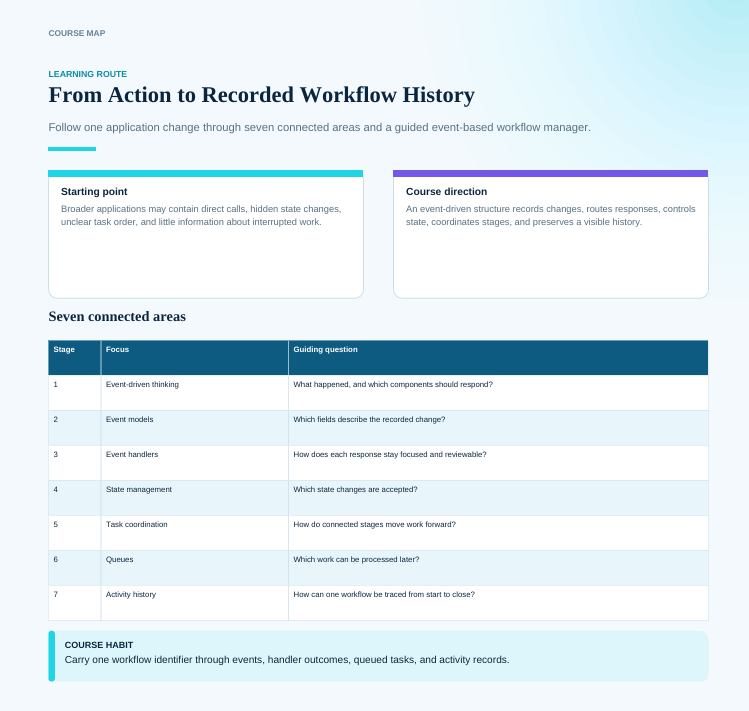
Broader projects often contain several components that need to react when information changes or a new action is requested. Directly connecting every component can create unclear dependencies and repeated instructions. Learners may find it difficult to track which part of an application should respond to a particular event. State changes can also become confusing when values are updated from several locations. Luma Series addresses these challenges through structured event handling, coordinated tasks, and clearly defined state transitions.
2. Solution
Luma Series introduces methods for organising applications around events, actions, and controlled state changes. Each module explains how one component can announce an event while another component responds through a defined handler. Learners practise separating event creation, processing logic, stored state, and response preparation. Guided activities demonstrate how connected tasks can be coordinated without placing every instruction inside one central file. The closing project brings these concepts together in an event-based workflow manager.
3. What’s Inside
The opening module introduces event-driven thinking. Learners examine how an application can respond to actions such as creating a record, revising information, changing a status, or completing a task. Flow diagrams show how an event moves from its source to one or several handlers.
A dedicated event-model module focuses on event names, event data, timestamps, identifiers, and source information. Learners create structured event objects and define the information each handler needs.
The handler section demonstrates how event responses can be divided into focused functions or classes. Activities include registering handlers, directing events, validating incoming data, and returning structured processing results.
A state-management module examines how an object or record moves between defined stages. Learners create state maps, describe permitted transitions, reject unsuitable changes, and record state history.
The task-coordination section explores workflows that contain several connected steps. Learners divide a broader operation into preparation, validation, processing, storage, and notification stages. Examples show how one completed task can trigger the next stage.
Another module covers queues and deferred work through conceptual Python structures. Learners practise adding tasks, processing them in order, recording their status, and responding when a task cannot be completed.
The course also introduces event records and activity histories. Learners create readable logs that explain what changed, when it changed, and which component handled the event.
A review module examines duplicated handlers, unclear event names, circular dependencies, oversized event data, and hidden state changes. Learners revise sample projects and prepare diagrams that describe the updated structure.
The closing project involves building an event-based workflow manager. Learners create tasks, assign states, route events, process handlers, record activity, and prepare structured summaries.
Included materials:
- Event-flow diagrams
- Event-model worksheets
- Handler registration exercises
- State-transition maps
- Workflow coordination tasks
- Queue-based activities
- Activity-history examples
- Dependency review checklists
- Module summaries
- A guided workflow manager project
- Reference notes
4. Who Is This For?
Luma Series is intended for learners familiar with modular architecture, classes, storage components, validation, testing, and command routing. It suits learners continuing from Cryst Library or those who want to organise applications around events and controlled state changes.
The course is also suitable for learners who have created multi-component projects and want to reduce direct dependencies between their parts.
5. What You’ll Learn
- How event-driven structures organise application behaviour
- How to create structured event objects
- How to register and direct event handlers
- How to separate events from processing logic
- How to define record states
- How to control permitted state transitions
- How to coordinate connected task stages
- How to organise queued work
- How to record event and state history
- How to review component dependencies
- How to identify circular event relationships
- How to document event pathways
- How to build an event-based workflow manager
6. 30-Day Refund Policy
Refund requests for Luma Series may be submitted within 30 days of the original purchase date. Each request is reviewed according to the refund terms published on the Nyrqelavol website.
Learners should provide their order details and the email address used during checkout. Approved refunds are returned through the original payment method. Processing periods may vary depending on the payment provider and banking procedures.
How are the course materials organised?
How are the course materials organised?
Each course is divided into structured modules that introduce Python concepts in a logical order. Topics include explanations, examples, guided tasks, and practice activities. Learners can move through the materials according to their own study schedule.
Do I need previous coding knowledge?
Do I need previous coding knowledge?
Previous coding experience is not required for introductory tiers. Each tier clearly outlines its intended learner level and the topics included. Higher tiers build on earlier concepts and introduce broader exercises, workflows, and project-based tasks.
What format do the courses use?
What format do the courses use?
The courses include written lessons, practical examples, code samples, exercises, reference materials, and module summaries. Some tiers also contain planning worksheets, project briefs, review tasks, and reusable coding structures.
Self-paced learning overview
- 📘 Digital file available after purchase
- 🗂️ Long-term availability
- 🔒 Secure checkout
- 🗓️ Content updated in 2026
Share