Nyrqelavol
Quantum Series
Quantum Series
Couldn't load pickup availability
1. Problem Statement
Complex Python projects can become difficult to maintain when architecture decisions are made only after development has already begun. Components may exchange information through unclear pathways, creating repeated logic and hidden dependencies. Testing can become fragmented when each section follows a different review method. Operational records may also provide too little detail to explain why a workflow stopped or produced an unexpected result. Quantum Series addresses these issues through structured planning, defined communication boundaries, coordinated testing, and detailed project observation.
2. Solution
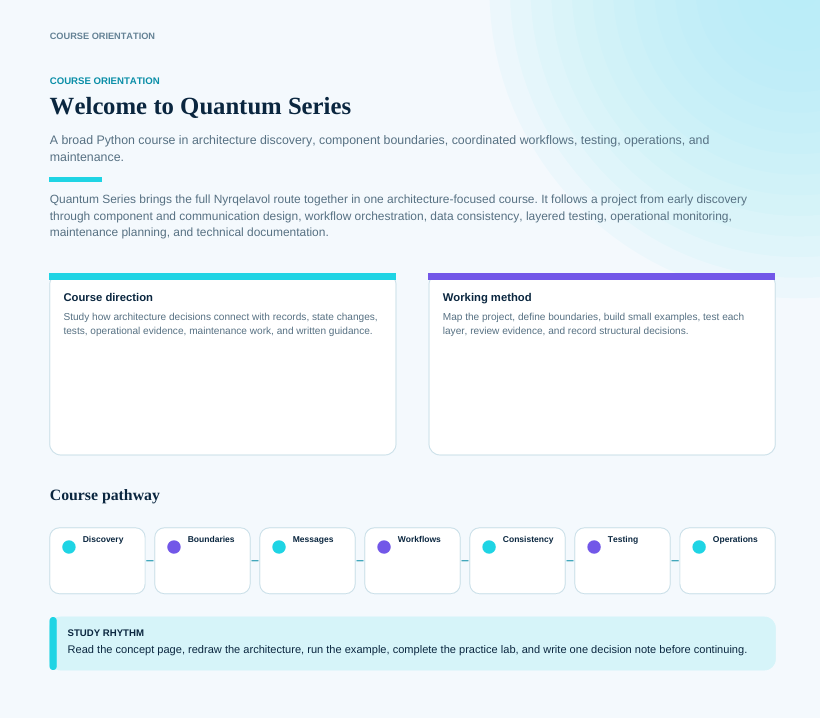
Quantum Series provides a comprehensive route for designing and reviewing multi-component Python applications. Each module connects architecture, data modelling, service communication, background tasks, testing, monitoring, and documentation. Learners prepare project diagrams before building individual components and define how information should move between them. Guided activities show how to examine behaviour at component, workflow, and application levels. The closing project combines the course topics within a coordinated processing environment supported by testing records and technical documentation.
3. What’s Inside
The opening module focuses on architecture discovery. Learners identify project goals, user actions, data sources, processing stages, storage needs, and output requirements. Architecture worksheets help turn these findings into clear component maps.
A boundary-design module examines how responsibilities can be divided between interfaces, services, data models, storage components, task handlers, and reporting sections. Learners review examples where boundaries are unclear and reorganise them into focused structures.
The communication module explores request models, response models, events, commands, and internal messages. Learners define required fields, validation rules, identifiers, and processing results for each communication type.
A workflow orchestration section covers operations that pass through several stages. Learners plan task order, state changes, interruption handling, retries, completion records, and alternative processing paths.
The data-consistency module examines how related records can remain coherent across several operations. Activities include validating updates, recording changes, preventing repeated actions, and reviewing incomplete transactions.
A layered testing section covers focused function checks, component interaction checks, workflow scenarios, and boundary cases. Learners prepare test data, expected outcomes, observed outcomes, and revision notes.
The monitoring module introduces structured measurements and operational summaries. Learners track task volume, completion states, processing attempts, interruption categories, and workflow duration without mixing monitoring logic with core application behaviour.
A maintenance section explores revision planning. Learners examine how to replace one component, add a new workflow stage, revise a data model, or change a message format while keeping related sections understandable.
The documentation module brings together architecture notes, data-flow diagrams, component descriptions, operation guides, testing records, and maintenance notes.
The closing project involves creating a coordinated processing environment with several connected services. Learners define the architecture, create message models, route tasks, validate records, manage workflow states, test interactions, record operational events, and prepare technical documentation.
Included materials:
- Architecture discovery worksheets
- Component boundary diagrams
- Message and response models
- Workflow orchestration exercises
- Data-consistency activities
- Layered testing templates
- Monitoring and review tasks
- Maintenance planning sheets
- Technical documentation frameworks
- Architecture review checklists
- Module summaries
- A guided closing project
4. Who Is This For?
Quantum Series is intended for learners familiar with modular architecture, event structures, service communication, task queues, testing, validation, storage, and workflow monitoring. It suits learners continuing from Nexus Series or those who already build broader Python applications with several connected components.
The course is also relevant for technical learners who want to study architecture decisions, component boundaries, operational review, and maintenance planning through detailed project work.
5. What You’ll Learn
- How to map a broader application architecture
- How to define clear component responsibilities
- How to design request, response, event, and command models
- How to organise multi-stage workflows
- How to manage state changes and interrupted operations
- How to support consistent data updates
- How to prevent repeated processing
- How to prepare several layers of testing
- How to examine component interactions
- How to record operational measurements
- How to plan structural revisions
- How to document architecture and data flow
- How to build a coordinated processing environment
6. 30-Day Refund Policy
Refund requests for Quantum Series may be submitted within 30 days of the original purchase date. Each request is reviewed according to the refund terms published on the Nyrqelavol website.
Learners should provide their order details and the email address used during checkout. Approved refunds are returned through the original payment method. Processing periods may vary depending on the payment provider and banking procedures.
How are the course materials organised?
How are the course materials organised?
Each course is divided into structured modules that introduce Python concepts in a logical order. Topics include explanations, examples, guided tasks, and practice activities. Learners can move through the materials according to their own study schedule.
Do I need previous coding knowledge?
Do I need previous coding knowledge?
Previous coding experience is not required for introductory tiers. Each tier clearly outlines its intended learner level and the topics included. Higher tiers build on earlier concepts and introduce broader exercises, workflows, and project-based tasks.
What format do the courses use?
What format do the courses use?
The courses include written lessons, practical examples, code samples, exercises, reference materials, and module summaries. Some tiers also contain planning worksheets, project briefs, review tasks, and reusable coding structures.
Self-paced learning overview
- 📘 Digital file available after purchase
- 🗂️ Long-term availability
- 🔒 Secure checkout
- 🗓️ Content updated in 2026
Share