Nyrqelavol
Slate Deck
Slate Deck
Couldn't load pickup availability
1. Problem Statement
Programs that work with broader collections can become difficult to organise when every operation is written inside one long sequence. Learners may repeat the same filtering, conversion, or formatting instructions across several sections. Large groups of values can also be harder to review when the code does not clearly separate collection, processing, and output stages. Some learners understand loops and functions but remain uncertain about iterators, generators, and concise collection techniques. Slate Deck addresses these challenges through focused modules built around readable data-processing workflows.
2. Solution
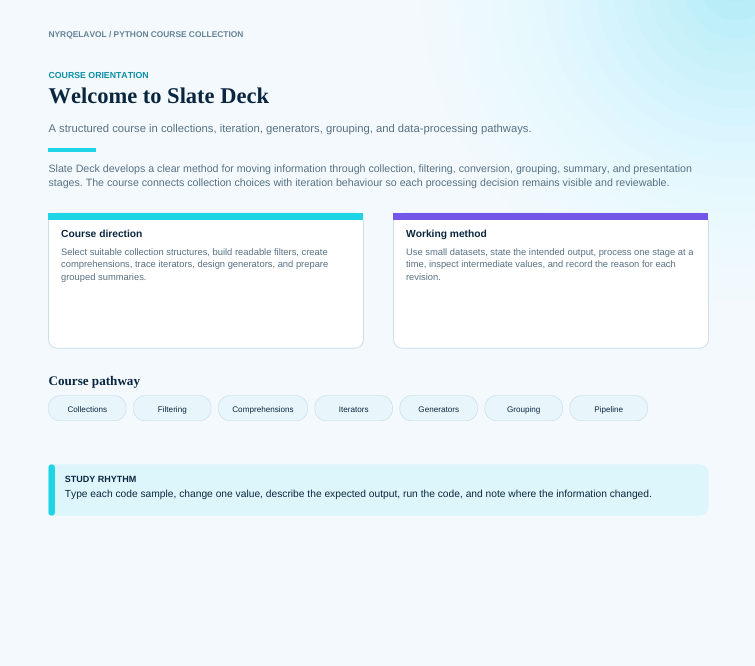
Slate Deck presents a structured route for working with collections and repeated operations in Python. Each module examines a specific processing stage and connects it with practical exercises. Learners study how information can move through collection, validation, filtering, grouping, and summary stages. The course introduces reusable iteration structures that reduce unnecessary repetition while keeping code understandable. A closing project brings the topics together within a multi-stage data review tool.
3. What’s Inside
The opening module reviews collection structures and examines how to select a suitable format for different information. Learners compare lists, tuples, sets, and dictionaries through tasks involving records, categories, repeated values, and lookup relationships.
A filtering module demonstrates how conditions can be used to select particular entries from a broader collection. Learners practise separating matching and non-matching values, removing repeated entries, and preparing revised groups for later processing.
The course then introduces collection comprehensions. Examples show how new lists, sets, and dictionaries can be created from existing information. Activities focus on keeping expressions readable and recognising situations where a standard loop provides greater clarity.
A dedicated module explores iterators. Learners examine how values are produced one at a time, how iteration state is maintained, and how custom iterable structures can be planned.
Generators are introduced as a practical method for producing values during a sequence. Learners write generator functions, review yielded values, and compare generator workflows with collections created in advance.
The grouping section covers sorting, category-based organisation, counting, and summary preparation. Learners create grouped records, calculate totals, identify repeated patterns, and prepare readable output.
Another module focuses on reusable processing pipelines. Learners divide a workflow into smaller functions for collection, validation, filtering, revision, and presentation. Planning sheets help define the input and output of each stage.
The closing project involves building a structured record analyser. Learners import sample records, validate fields, filter entries, group related information, calculate summaries, and produce a formatted report.
Included materials:
- Detailed written modules
- Annotated collection examples
- Filtering and grouping exercises
- Comprehension practice tasks
- Iterator diagrams
- Generator activities
- Processing-pipeline worksheets
- Data-summary exercises
- Code-review checklists
- Module summaries
- A guided record-analysis project
- Reference notes
4. Who Is This For?
Slate Deck is intended for learners familiar with collections, functions, files, error management, and class-based structures. It suits learners continuing from Drift Module or those who want deeper practice with repeated data operations.
The course is also suitable for learners who work with broader information groups and want to organise processing stages more clearly. Prior experience with foundational Python concepts is recommended.
5. What You’ll Learn
- How to select suitable collection structures
- How to filter values with conditions
- How to remove repeated entries
- How to create list, set, and dictionary comprehensions
- How iterators produce values in sequence
- How to write generator functions
- How to sort and group records
- How to count and summarise information
- How to divide processing into separate stages
- How to define input and output for each function
- How to review data-processing code
- How to build a multi-stage record analyser
6. 30-Day Refund Policy
Refund requests for Slate Deck may be submitted within 30 days of the original purchase date. Each request is reviewed according to the refund terms published on the Nyrqelavol website.
Learners should provide their order details and the email address used during checkout. Approved refunds are returned through the original payment method. Processing periods may vary depending on the payment provider and banking procedures.
How are the course materials organised?
How are the course materials organised?
Each course is divided into structured modules that introduce Python concepts in a logical order. Topics include explanations, examples, guided tasks, and practice activities. Learners can move through the materials according to their own study schedule.
Do I need previous coding knowledge?
Do I need previous coding knowledge?
Previous coding experience is not required for introductory tiers. Each tier clearly outlines its intended learner level and the topics included. Higher tiers build on earlier concepts and introduce broader exercises, workflows, and project-based tasks.
What format do the courses use?
What format do the courses use?
The courses include written lessons, practical examples, code samples, exercises, reference materials, and module summaries. Some tiers also contain planning worksheets, project briefs, review tasks, and reusable coding structures.
Self-paced learning overview
- 📘 Digital file available after purchase
- 🗂️ Long-term availability
- 🔒 Secure checkout
- 🗓️ Content updated in 2026
Share